De Dolle Brouwers
Brewery
About this Brewery
Place: Esen
De Dolle Brouwers — literally “The Mad Brewers” — emerged in 1980 from an appropriately unconventional beginning. Brothers Kris and Jo Herteleer had been experimenting with beer while students, including brewing a prototype of what became Oerbier in a copper wash basin. Together with fellow members of their tiny cycling club, De Dolle Dravers (“The Mad Pedallers”), they took over an empty brewery in Esen and became De Dolle Brouwers.
The brewery they revived was considerably older. Brewing on the site dates to 1835, when doctor Louis Nevejan established a brewery and later distillery. Alois Costenoble acquired it in 1882 and brewing continued under successive generations of the Costenoble family. The buildings also witnessed a darker chapter in Esen's history during the First World War, when German forces used the brewery complex to confine hundreds of local civilians in 1914.
Oerbier became De Dolle's first beer in 1980 and established much of the character that still defines the brewery: distinctive, bottle-conditioned beers produced on a deliberately small scale using traditional equipment and methods. The range subsequently expanded to include Arabier, Boskeun, Dulle Teve and Stille Nacht, its formidable Christmas beer, alongside other and occasional releases.
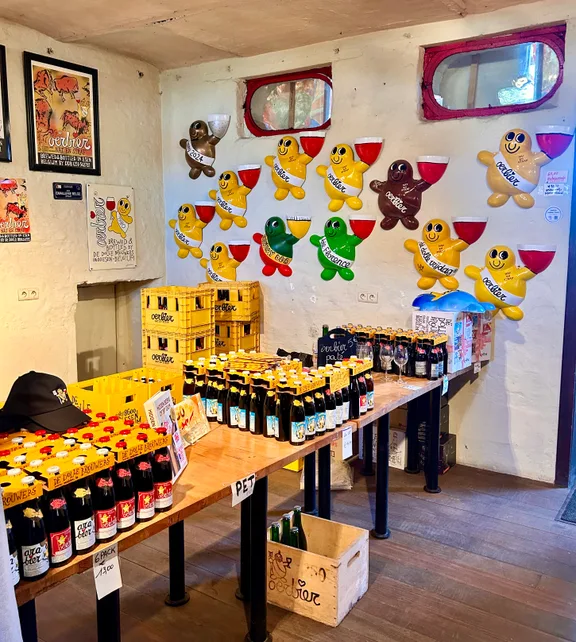
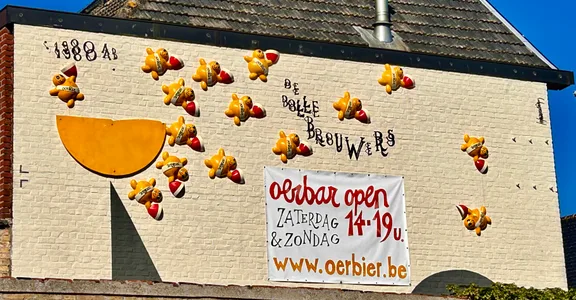
The brewery's visual identity is largely the work of brewer and artist Kris Herteleer. Its exuberant Oerbier figure appears throughout the historic brewery in paintings, signs and three-dimensional forms, helping make De Dolle's surroundings almost as distinctive as its beers.
The name itself preserves the brewery's origins. De Dolle Dravers was a four-man cycling club comprising the Herteleer brothers, Dirk Coussée and Bernard Veranneman; its clubhouse had previously served as a pigeon loft and later a washhouse. In 1980, the Mad Pedallers became the Mad Brewers.
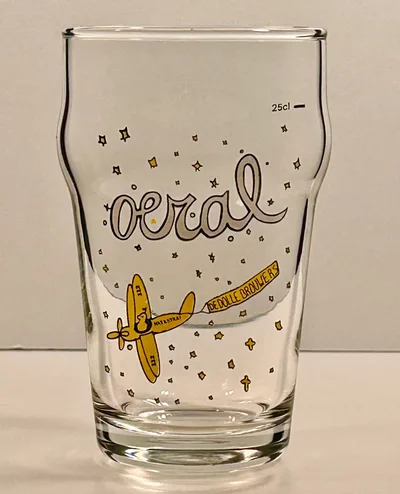
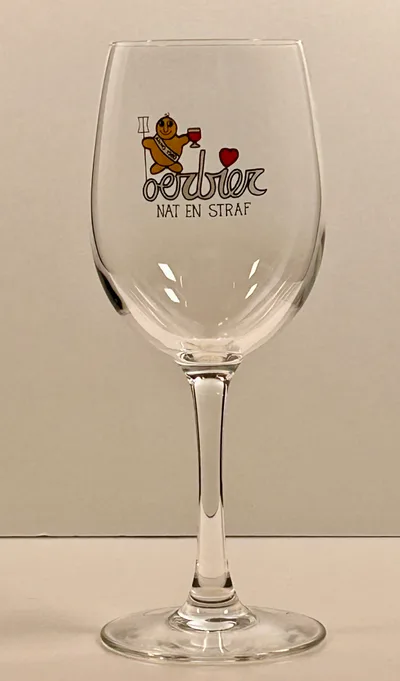
Glasses in this collection
Curator's Note
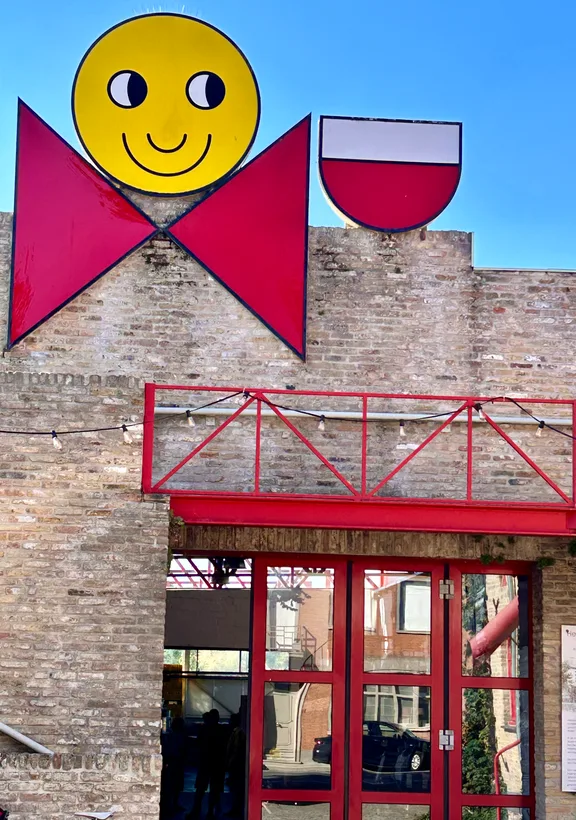
Nothing quite prepares you for De Dolle Brouwers.
From the street, the old brewery announces itself with enormous smiling Oerbier figures, bow ties, glasses of beer and lettering scattered across the brickwork. Inside, things become considerably less restrained.
Calling the sales area a “shop” may be overselling the concept. Bottles, glasses and surprisingly excellent merchandise are arranged across trestle tables beneath a collection of Oerbier figures covering the walls. Beyond is a large, slightly ramshackle bar and seating area, with more space outside. It feels chaotic, eccentric and gloriously homemade — although spend a little time here and it becomes difficult to believe that any of the apparent madness is accidental.
Beer can be bought to drink or take away, alongside branded glasses and clothing. Staff are friendly, knowledgeable and distinctly informal. Dogs are warmly welcomed.
One practical warning: payment is by cash or bank transfer rather than card, and there is no cash machine at the brewery. Visitors intending to buy beer or merchandise would be wise to arrive with cash rather than assume the usual electronic payment options will be available.
Tours are another part of the experience. On our visit the English-language tour was due to begin at 14:00. At around 14:20, our prospective guide eventually appeared wearing a bright yellow jacket decorated with his own Oerbier artwork. Regrettably, the Museum's curator had already decided that asking his wife and dog to wait another hour would be unreasonable.
He has regretted this decision ever since.
De Dolle is not somewhere to visit because you happen to be passing through Esen. Esen is somewhere to visit because De Dolle is there. Allow time, embrace the eccentricity — and take the tour.