
Belgium's Three Regions
Belgium is divided into three Regions: Flanders, Wallonia and the Brussels-Capital Region. Each has its own government and distinct geography, history and identity.
The Regions are territorial and do not precisely match Belgium’s language-based Communities—one reason Belgian politics can appear complicated. For beer enthusiasts, they also provide a useful map of the country’s brewing traditions.
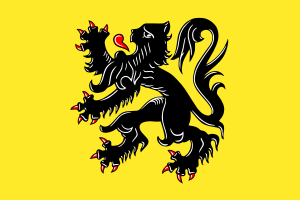
Flanders
At a Glance
| Official name | Flemish Region (Pop: approx. 6.8m) |
|---|---|
| Location | Northern Belgium |
| Language | Dutch, often informally called Flemish |
| Principal places | Antwerp, Ghent and Bruges |
The Region in Brief
Flanders stretches from the North Sea coast to the Dutch border. Its medieval cities prospered through manufacturing and international trade, connections maintained today through major ports, modern industry and extensive transport networks.
Dutch is the official language. “Flemish” commonly describes the Dutch spoken in Flanders, with its local accents and vocabulary, rather than a separate official language.
Brussels is the capital and seat of the Flemish institutions, although the city itself forms a separate Region.
Beer and Brewing
- Signature traditions: Flemish Brabant is associated with witbier, most famously through Hoegaarden. The countryside west of Brussels is part of the historic lambic-producing area, where spontaneous fermentation gives rise to lambic, gueuze and fruit beers such as kriek.
- Regional specialities: East and West Flanders are known for Flemish red and brown ales. These complex beers may employ mixed fermentation, maturation in large wooden vessels, and the blending of younger and older beer.
- Brewing landmarks: Flanders is home to the Trappist breweries of Westmalle and Westvleteren, alongside historic family breweries, international producers and a lively independent brewing scene.
No single style defines Flemish brewing: its most distinctive quality is its remarkable variety.
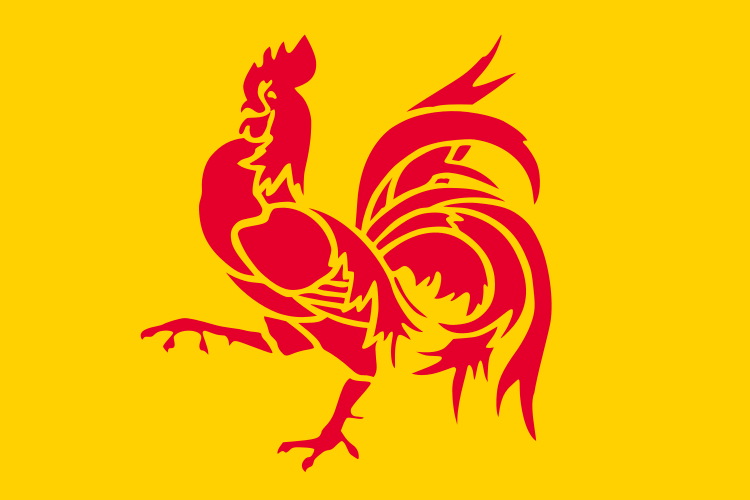
Wallonia
At a Glance
| Official name | Walloon Region (Pop: approx. 3.7m) |
|---|---|
| Location | Southern Belgium |
| Languages | Predominantly French, with a German-speaking area in the east |
| Principal places | Liège, Namur and Charleroi |
The Region in Brief
Wallonia is Belgium’s largest Region by area. Its landscape ranges from the former industrial valleys of the Sambre and Meuse to the hills, forests and small towns of the Ardennes.
Once a major European centre of coal, steel, engineering and glassmaking, Wallonia now combines its industrial inheritance with sectors such as aerospace, biotechnology, logistics and food production.
French is the principal language. Belgium’s German-speaking Community occupies an area in eastern Wallonia, while Walloon is a traditional regional language distinct from French.
Beer and Brewing
- Signature tradition: Wallonia is particularly associated with saison. These dry, refreshing beers have roots in the farms and agricultural communities of Hainaut, although modern interpretations vary considerably.
- Trappist brewing: Three of Belgium’s Trappist breweries—Chimay, Orval and Rochefort—are in Wallonia. Their distinctive beers are internationally recognised expressions of Belgium’s Trappist tradition.
- Abbeys and independents: Numerous beers carry the names of Walloon abbeys, although an abbey beer is not necessarily brewed within the abbey it represents. Long-established family breweries and newer independent producers add still more variety.
Walloon brewing reflects its landscape: farms, abbeys, small towns and strongly local traditions.

Brussels-Capital Region
At a Glance
| Official name | Brussels-Capital Region (Pop: approx. 1.2m) |
|---|---|
| Location | Central Belgium, surrounded by Flanders |
| Languages | Officially French and Dutch |
| Composition | 19 municipalities, including the City of Brussels |
The Region in Brief
The Brussels-Capital Region is geographically small but occupies a unique position. It is Belgium’s capital, a separate Region and the home of major European and international institutions.
Brussels grew from a settlement on the River Senne into an important commercial and administrative centre. Today its economy is dominated by government, international organisations and business services.
The Region is officially bilingual. French is more widely spoken in everyday life, while international migration has made modern Brussels highly multilingual.
Beer and Brewing
- Signature tradition: Brussels is inseparably connected with lambic, produced through spontaneous fermentation. Instead of adding a cultivated brewing yeast, the brewer exposes cooled wort to microorganisms present in the brewery environment.
- The lambic family: Lambic may be served unblended, fermented with fruit to produce beers such as kriek, or blended at different ages and refermented in the bottle to make gueuze. The tradition extends into the neighbouring Senne valley and Pajottenland.
- Brewing landmarks: Cantillon, founded in Anderlecht in 1900, is the city’s best-known surviving lambic brewery and houses the Brussels Museum of Gueuze. A lively independent brewing scene now complements this historic tradition.
Brussels combines a centuries-old, place-specific brewing tradition with a modern international beer culture.