Catalogue no. BBG242
Glasses
Exhibit information
Beer style Tripel A strong, pale Belgian ale traditionally associated with Trappist and abbey brewing, combining substantial strength with a relatively light appearance.
Read in Explainer
Explainers Glass style Goblet A stemmed glass with a broad bowl, traditionally associated with stronger Belgian beers, particularly Trappist and abbey ales.
Read in Explainer
Explainers
Capacity 33cl / 25cl
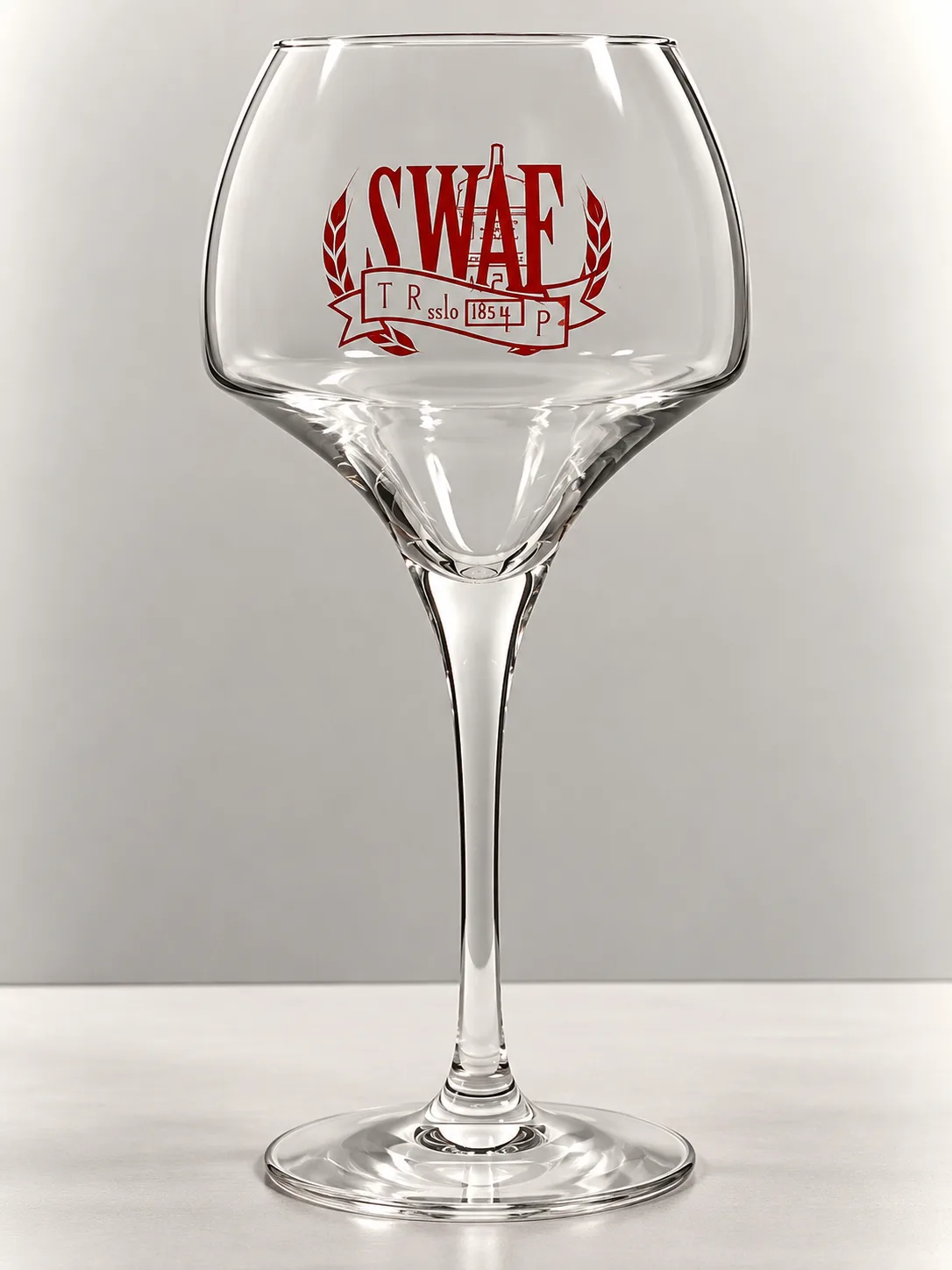
Manufactured 2025 Curator’s Notes Few glasses in the Museum combine such generous proportions with such apparent delicacy as this striking SWAF Triple glass from Brasserie de Silly.
Its unusually shaped bowl is broad and rounded across the upper section, with a gently inward-curving rim and a pronounced narrowing towards the base. Beneath it, the glass tapers dramatically into an exceptionally long, slender stem that meets a broad, relatively shallow circular foot. The contrast between the substantial bowl and its almost impossibly delicate support gives the glass an unmistakably elegant, even theatrical appearance.
The decoration is comparatively restrained. The SWAF name appears in bold, elongated red lettering, flanked by stylised ears of grain and accompanied by a ribbon bearing the word Triple. The design deliberately distinguishes SWAF from the brewery's more familiar house branding, giving the beer an identity of its own.
SWAF Triple was introduced by Brasserie de Silly in 2016, as a bottle-conditioned Belgian tripel with an alcohol content of 8%. The brewery made a particular feature of the glass when launching the beer, describing its choice as a prestigious, tall-stemmed design intended to complement the new addition to its range. SWAF subsequently received a gold medal at the Asia Beer Challenge in 2020.
Although the glass shares some characteristics with the tall-stemmed balloon used for the brewery's Abbaye de Forest beer, its proportions are markedly different. The SWAF design has a more angular transition between bowl and stem, while the exceptionally slender lower section gives it a distinctive silhouette.
On the reverse are the glass's capacity and conformity markings, including measurements of 25cl and 33cl.
Above these is a small pictogram resembling a traditional brewing vessel or kettle. Its precise significance has not been established, but it is an intriguing additional detail on an otherwise sparsely decorated glass.
I bought this glass during my visit to Brasserie de Silly in October 2026. Of the glasses available from the brewery's sales office, this was perhaps the most unexpected discovery. Its extraordinary proportions immediately caught my attention, although its delicate construction means it may spend rather more time being admired than used.